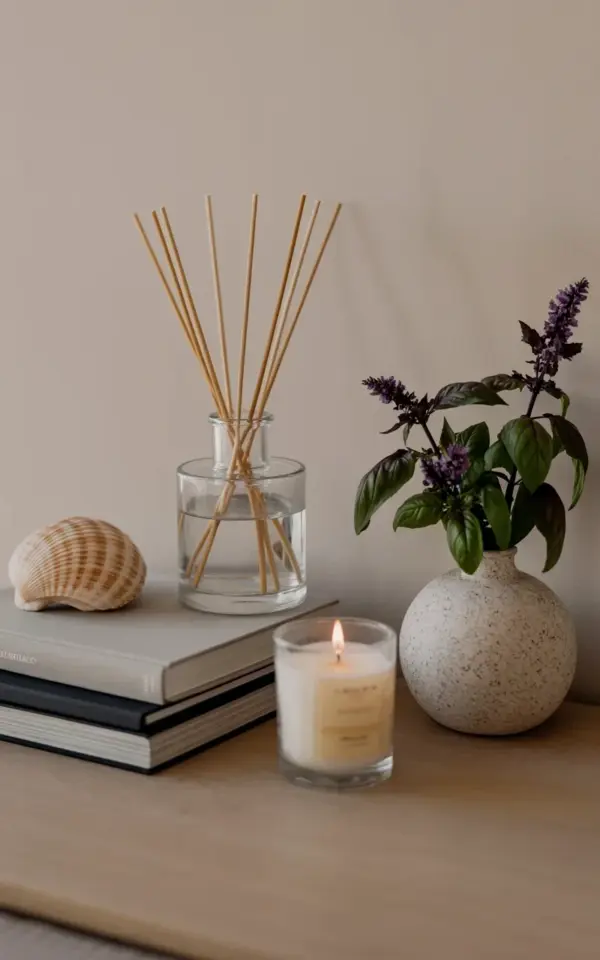
I am a total sucker for a good reed diffuser, but not gonna lie, I used to think nice home decor meant spending way too much money. Then I put together this little shelf corner, and honestly, it changed my whole approach. The reed diffuser sits there in its clear glass container, light brown sticks poking out, and it anchors the whole scene without shouting. The best part? None of it broke the bank. Not the thrifted books. Not the seashell I found on a damp morning walk. Not even the purple basil from the farmers market that cost less than a coffee. Simple reed diffuser decor on a budget can actually look like you tried, just without the credit card bill.
Clear Glass Reed Diffuser: The Minimalist Shelfie Anchor
Look, you do not need a fancy ceramic vessel or some designer shape. A plain cylindrical glass diffuser works perfectly, especially if the liquid inside has a pale golden tone. That transparency becomes a feature, not a compromise. It lets light pass through and plays nicely with whatever is around it, like the black and gray books stacked to the left.
Here is the thing about minimalist decor: it relies on a few strong elements, and the reed diffuser is your quiet hero. The reeds themselves add vertical lines and a touch of organic texture. I picked mine up at a discount home store for under ten dollars. And the scent? Vanilla and sandalwood, nothing fancy, but it lingers softly. You don’t need expensive oils. Just buy a refill set online and reuse the same bottle. Anyway, the clear glass format makes it super easy to swap out reeds or even add a drop of food coloring if you want a tint. Not that I do that, but you could.
Thrifting for Decor: Books, Shells, and More
The stacked books in the photo? Both of them are thrifted. One is a black hardcover, the other a gray one, and together they create a little pedestal for that beige seashell. Thrift stores are goldmines for this stuff, but you have to dig. Here is a quick list of what I look for when thrifting shelf decor:
- Hardcover books with uniform spines, any color that matches your palette. Black and gray are safe bets.
- Small ceramic vases or bowls, even if they have minor chips (sand the rough edge).
- Candles in simple glass holders, often half-burned but still good.
- Odd little natural objects like driftwood, large pinecones, or fake coral if you want a beachy vibe without a shell.
I spent exactly three dollars on those two books. The seashell was free, obviously, but I will get to that in a minute. The white candle in the glass holder came from a garage sale for fifty cents. Honestly, I almost passed it up because the wax had a small crack, but once lit, who cares. That is the budget decor mindset: look past tiny flaws.
Using Farmer’s Market Finds as Budget Decor
Ok so the purple basil in the speckled gray ceramic vase is maybe my favorite part, and it cost two dollars. Not two dollars for the vase. Two dollars for the whole bunch of basil at the farmers market. I stuck it in a vase I already had, and it became an instant floral arrangement. The thing about using fresh herbs as decor is they smell amazing and they also degrade, which forces you to rotate your styling. That is not a downside. It makes your shelf feel alive and changing.
I will say, that purple basil specifically has this deep aubergine color that looks great against the neutral beige background and the gray speckles on the vase. And the leaves smell like licorice, which I did not expect. Not everyone likes licorice. But it adds a weird little detail to the corner. If you try this, pick herbs with strong stems, like rosemary or lavender. Basil is a bit floppy after a few days, so you might need to prop it up. I used a small pebble in the bottom of the vase to hold the stems steady. That pebble was from my driveway. Free.
Layering Textures Without Spending a Fortune
Minimalist decor sometimes looks flat if everything is smooth and shiny. You need texture contrasts, and you do not need to buy anything new. Look at the shelf: the wood surface is light and matte. The books are rough paper and cloth. The glass diffuser is slick and transparent. The seashell has a ribbed, slightly gritty surface. The vase is speckled stoneware. That is five different textures, all from existing or cheap items.
One trick I use is grouping things with different heights. The reed diffuser is the tallest, then the basil in the vase, then the candle, then the shell on the books. That stair-step effect draws the eye across the shelf. If you have an empty corner, try layering a small stack of coasters under a candle or a tiny plant. Seriously, wrap a rubber band around three coasters and call it a pedestal. I have done that. It works.
The Seashell: A Free Natural Element That Steals the Show
That seashell is a beige scallop shell, probably a common Atlantic variety. I found it on a beach in New Jersey, half buried in wet sand. Not a vacation beach, just a regular weekday when I had nothing better to do. I rinsed it off in a puddle. It had a little piece of dried seaweed stuck to the hinge, which I picked off later with a toothpick. That is the level of detail I am talking about. Free, found, and it adds a story.
You could substitute any natural object: a piece of driftwood, a smooth river stone, a dried starfish from a dollar store if you live inland. The point is, nature makes the best decor. And it costs nothing. Place it on top of something, like books or a folded cloth, to give it importance. Do not just toss it on the shelf. Elevate it, literally. Then it becomes a focal point instead of clutter.
Reed Diffuser Placement and Shelf Styling Tips
Where you put the reed diffuser matters for both looks and function. You want it somewhere where the reeds can breathe but not where someone will knock it over. On a shelf, avoid the edge. Tuck it in slightly, like I did, with the books on one side and the vase on the other. That keeps it protected. Also, consider the color of the reeds. Light brown is neutral. Dark brown or black reeds would change the vibe entirely, more dramatic. I prefer the light ones because they match the wood shelf and the beige background.
Another practical tip: flip the reeds every week to refresh the scent throw. But do that over the sink because oil drips. And if you want the diffuser to last longer, use fewer reeds. I started with five, but I pulled out two. Now the scent is subtle, which I prefer anyway. You can also rotate the bottle slightly each week so the liquid moves around. Not a big deal, but it keeps the oil from settling too much. Honestly, this is the kind of low-effort maintenance that makes budget decor feel intentional.
Why This Corner Works: Cozy and Wallet-Friendly
This whole shelf setup cost me maybe fifteen dollars total, including the diffuser and the farmers market basil. And it looks like something out of a catalog. The secret is limiting your palette to neutrals with one color pop, the purple basil. That single accent color draws the eye without chaos. The seashell breaks up the hard lines of the books. The candle adds a warm softness, even unlit. Everything has a purpose and a place.
If you recreate this, do not overthink it. Start with one item you already love, like a thrifted book or a free shell, and build around it. Let the reed diffuser be your anchor. Everything else is just supporting cast. And if you mess up the arrangement, just shift things around until it feels right. There is no rule book. Only your shelf and your budget.
So go raid your beach bag, check the thrift store shelf, and pick up some basil next Saturday. You will be surprised how good a ten-dollar corner can feel.
#reeddiffuser #minimalistdecor #budgetdecor #homestyling #affordablehomedecor
Leave a Comment